The question comes up in every initial meeting. At some point, usually toward the end,
when the technical details have been clarified and both sides sense it could be a fit. Then the client asks: "And what happens afterward? When you're done?"
It's the most important question in a first meeting. And our answer has changed.
The Old Model
Knowledge transfer used to mean: pair programming, joint code reviews, architecture workshops. Your team builds alongside ours so they understand the code. That was well-intentioned. And it was better than a PDF at the end of the project.
But it had limits. New team members joined and had to start from scratch. Documentation became outdated the moment the first hotfix went live. Knowledge lived in the heads of individual people. And when they left, it was gone.
How We Do It Today
We don't just build your system. We build agents that become part of your system.
Agents that explain to your team why the architecture is designed the way it is. Agents that automatically generate and maintain documentation. Agents that help your engineers develop new features without needing to understand every line of the existing code.
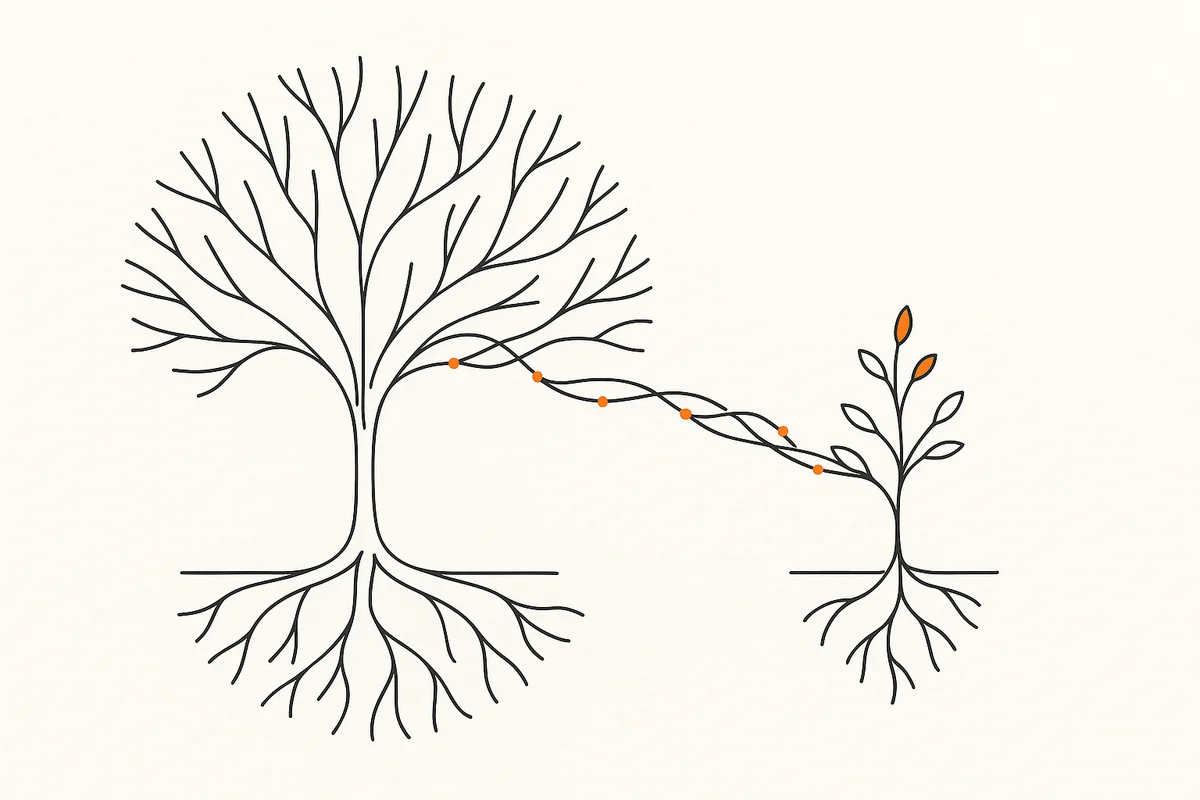
Knowledge transfer is no longer an event or a process. It's a tool that stays when we leave.
What This Means in Practice
Documentation that writes itself. Our agents generate technical documentation directly from the code. Architecture decisions, API references, deployment processes. Not as a one-time export, but continuously. Every change to the code automatically updates the documentation. Your team always works with the current state.
Architecture that explains itself. Why does the system use event-driven architecture?
Why is the service in a separate VPC? Why was DynamoDB chosen over Aurora? Our agents answer these questions. Not from a static FAQ, but from the context of the actual code and documented decisions.
Development with support. Your team wants to build a new feature? The agent knows the codebase, the patterns, the conventions. It suggests where the code belongs, which tests are needed, which existing services are affected. Your team doesn't need six months of onboarding. It needs an agent that has the context.
Operations without dependency. Agents that analyze CloudWatch errors, diagnose infrastructure issues, and suggest solutions. Not as a monitoring dashboard that nobody reads. As an active tool that detects problems and provides actionable recommendations.
How It Works at Siemens Energy
The HR Data Hub started as a project with a clear scope: replace SAP licenses, build a self-service data shop, save 800,000 EUR per year.
Today, Siemens Energy operates the platform independently. Not because we did months of pair programming. But because the agents we built for the platform have become part of the Siemens Energy toolkit.
The AWS Architect Agent analyzes CloudWatch errors and repairs infrastructure.
The Documentation Agent keeps the technical documentation in sync with every code change. When a new engineer joins the team, a colleague doesn't explain the architecture for three days. The agent does. On-demand, as often as needed, always current.
This is knowledge transfer that scales. It doesn't depend on individual people. It doesn't become outdated. And it works the day after we leave just as well as the day before.
No Black Boxes
One important point remains: Everything we build belongs to you. Completely.
No proprietary framework that only we understand. No agents that only run with our license.
The agents are based on your code, run in your infrastructure, use your data. If you decide tomorrow to evolve everything independently, you can. Without asking us.
What This Means for You
When you work with FNTIO, you don't just get a system. You get a system with built-in intelligence that empowers your team.
When we leave, we don't leave a vacuum. We leave agents that help your team understand, evolve, and operate the system. Not because knowledge transfer happened in a workshop. But because it's part of the system.