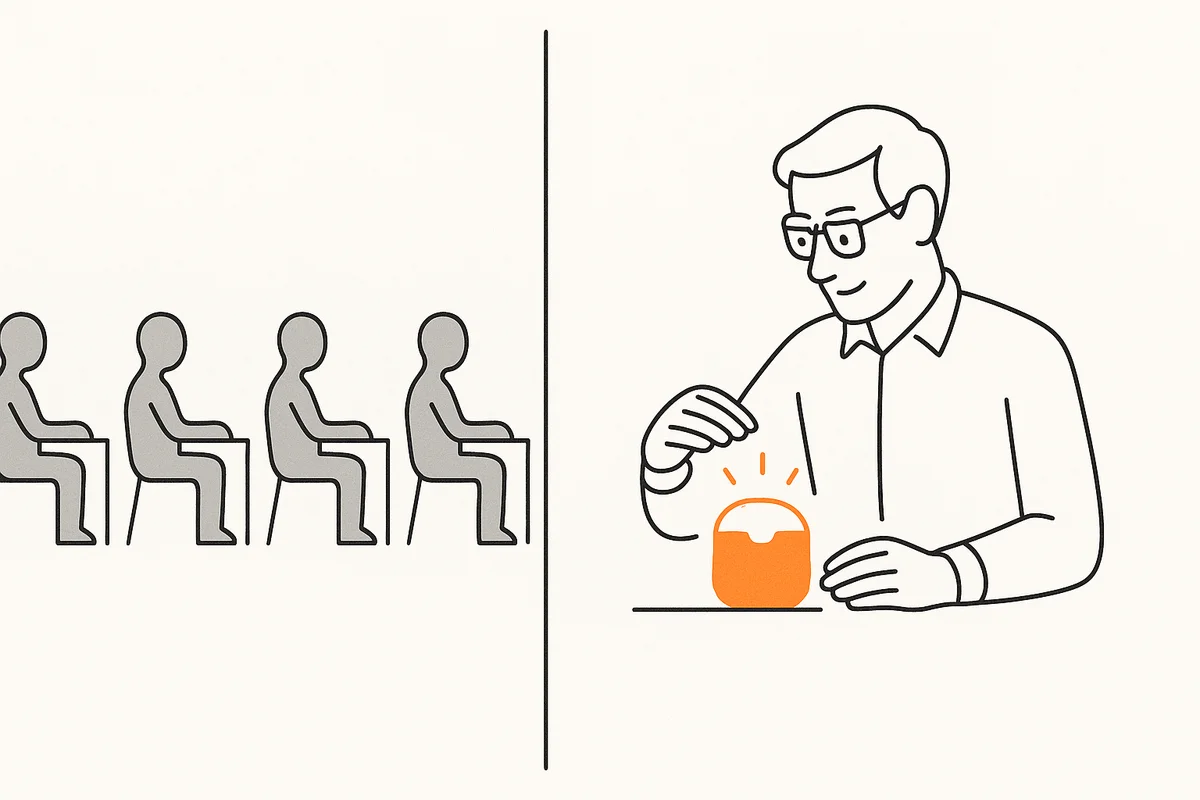
We worked in the hourly model for years. T&M, hourly rates, utilization targets. That was the business model. And it worked. Until we realized it was holding us back from what we actually want to deliver: outcomes.
The Realization
In the hourly model, time counts, not the outcome. A developer works according to the client's processes, uses their tools. It works, but it limits what's possible. The real strength of a specialized partner never comes into play: making your own architecture decisions, taking accountability for the outcome, treating the product as your own.
We wanted to deliver more than capacity. We wanted ownership.
What AI Changed
AI rewrote the rules. Not theoretically, but in our daily work.
An engineer with AI tools now handles tasks that required three engineers two years ago. Code generation, testing, documentation, infrastructure provisioning. AI takes over execution. The human focuses on architecture and decisions.
When an engineer with AI is three times as productive, the hourly model becomes absurd. The client pays for three hours and gets the output of nine. Or we reduce the hours and our revenue drops. Neither makes sense.
The logical consequence: Don't bill by the hour, bill by outcomes.
What Works Instead
Since we shifted to project-based work, everything has changed:
Ownership emerges. When our team is responsible for the outcome rather than just the hours worked, everyone thinks differently. Architecture decisions become more long-term. Quality becomes a matter of self-interest. The product becomes our product.
Speed increases. We decide ourselves how to deploy AI. No need to coordinate with the client's IT team. No process for every new tool. We use whatever gets us to the outcome fastest.
The right partnerships form. Clients who want outcomes seek the best partner.
These partnerships are deeper, longer-lasting, and more valuable for both sides. A first project leads to a second, then a third. Not because of a framework agreement, but because the results speak for themselves.
Honestly: It Wasn't Easy
The transition was a process. Not every client wanted to go this route. The team had to shift its mindset: From "I work at the client" to "I deliver an outcome for the client."
Project-based work requires discipline: precise planning, realistic estimates, and fast learning. Outcome ownership means we hold ourselves to our own standards.
But that's exactly what makes us better. Every project teaches us something. Every miscalculation improves the next estimate. And AI helps us iterate faster than would ever be possible with headcount alone.
What This Means for Clients
If you're looking for a partner who treats your product as their own: Let's talk. We take accountability for the outcome and use AI as our tool.
We deliver projects. With outcome ownership, with accountability, and with the conviction that great software comes from genuine commitment.