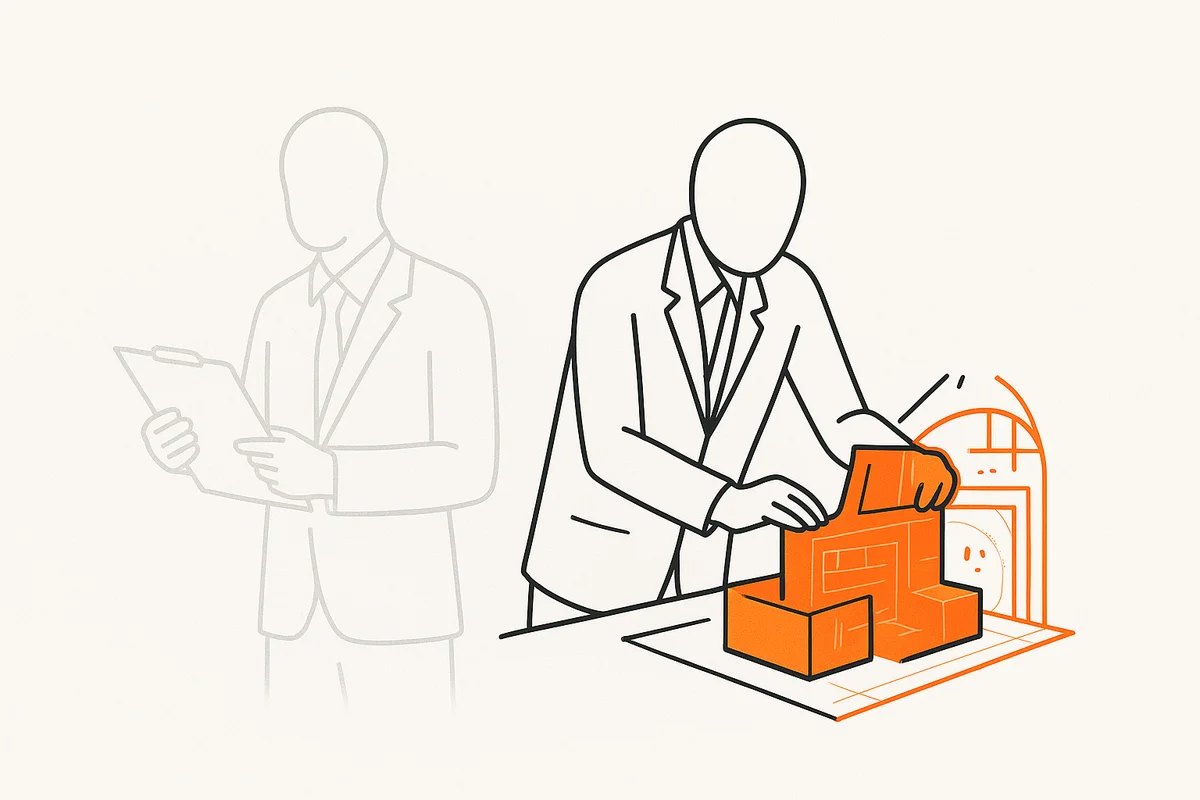
The role of the IT consultant is changing fundamentally right now. And that's good news for everyone involved.
A Role in Transition
For a long time, the consultant role was clearly defined: analyze, plan, recommend. Requirements documents, architecture blueprints, handover to a development team.
Then the real work begins. This model worked because software development was expensive and slow. Planning was necessary because every line of code cost money and mistakes were hard to correct.
AI has changed that. Fundamentally.
What AI Does to the Consultant Role
Code has become cheap. Not in the sense that it's worthless. But in the sense that the cost of an iteration approaches zero. An engineer with AI tools can test 20 different approaches in a single day. Not on paper. Not as a mockup. As working code.
This means: The planning phase becomes implementation. The analysis becomes a prototype. The recommendation becomes an experiment.
And the consultant? The consultant becomes a product manager.
The New Workflow
Here's what this looks like in practice:
Days 1-3: The team understands the client's problem. Not through interviews and workshops, but through experimentation. Three, four prototypes emerge.
Each demonstrates a different approach. Each works. None is perfect.
Days 4-5: The client sees the prototypes. Not as a presentation, but as running software. Click, test, give feedback. Two approaches get discarded. One gets developed further.
A new approach emerges from the feedback.
Weeks 2-4: Iteration. New versions daily. Daily feedback. AI generates code.
Engineers make architecture decisions. The client sees progress. Every day.
Months 2-3: Production readiness. Security review. Performance optimization. Go-live.
Three months. Not three months of planning followed by six months of development. Three months from idea to product.
Why Systems Engineers Are Made for This Role
This way of working requires technical depth. The ability to make an architecture decision in minutes. The judgment to know which prototype scales and which doesn't.
Systems engineers have that. They've built large systems. They know what holds up in production and what looks good in a demo but collapses under load. They know the difference between a clever solution and a robust one.
AI takes over code production. But the decision of which code to write remains with the human. And for that decision, you need experience. Architecture experience from real enterprise projects.
What Clients Gain From This
Faster results. Instead of having a plan after three months, you have a product after three months.
Less risk. Every prototype is a test. Bad ideas fail in days, not months. That saves money and protects against costly misjudgments.
Better products. When the consultant builds the software themselves, they understand the constraints. Requirements and implementation come from the same source. The result fits reality.
What This Means for the Industry
The consultant role is changing. From the planning phase toward execution.
From recommendations toward accountability. This is an opportunity for everyone willing to evolve.
The enterprise consultant in 2026 is a product manager with technical depth who uses AI as a tool and takes accountability for the outcome.
That's what the future of consulting looks like. In production, at enterprise clients.